Iroh global content discovery
by Rüdiger KlaehnWhat got me excited about IPFS many years ago briefly after it was announced was the following use case: publish a personal website, blog post, or political pamphlet, and as long as enough people are interested in the content, it will remain available globally.
Iroh started as an IPFS implementation, so initially we also tried to solve this problem. But when we parted ways with IPFS compatibility and later narrowed down the scope of what iroh is to direct connections dialed by key, we focused on other things.
But that doesn't mean that I am no longer interested in the problem. I did some experiments in the past, and now that iroh has reached 1.0 we should take another look.
Recent events have added some urgency to this. IPFS shipyard is shutting down. This does not mean that IPFS will stop working, but it does not bode well for the future of the project.
The state of the art
When we solved hole punching, we started looking at existing systems and chose the best open source system as an initial starting point for our own implementation. So let's do the same for global content discovery.
There are a number of projects trying to solve this problem. But one project stands above all others: BitTorrent. It just works and has done so for over two decades.
So let's take a look at what makes BitTorrent the current leader in permissionless global content discovery. BitTorrent has a relatively simple protocol for blob transfer and a DHT called Mainline for global content discovery.
The transfer protocol and content discovery are separate systems. In fact, the DHT was developed later than the transfer protocol. BitTorrent was released in 2001 using centralized trackers for content discovery; the Mainline DHT was added in 2005.
Transfer protocol
BitTorrent works by creating a .torrent file that contains information about the data to be downloaded. The file is encoded using bencode, which is conceptually similar to JSON.
{
  "announce": "http://tracker.example.com/announce",
  "comment": "Ubuntu 24.04 desktop image",
  "created by": "mktorrent 1.1",
  "creation date": 1714521600,
  "info": {
    "name": "ubuntu-24.04-desktop-amd64.iso",
    "piece length": 262144,
    "length": 5820411904,
    "pieces": 9358b5d71f8007ac926000961ad79d865d9652bc
              4cce840457bcfac1dd67d864e9386422eee70904
              … many more 20-byte hashes …
  }
}
pieces contains the concatenated SHA-1 hashes of all piece length-sized pieces. The transfer protocol downloads blocks of these pieces from different peers.1
The transfer protocol allows requests for ranges within pieces, but you can only validate a piece after you have downloaded it completely and computed its SHA-1 hash.
I don't want to dwell on this too long, but I think that BLAKE3 verified streaming is a superior replacement for the transfer protocol.
For a visual explanation of how it works, see my BLAKE3 and Bao deep dive, which covers verified streaming, outboard encoding, and range requests.
We still have some work to do to make multiprovider downloads of single blobs efficient, but the streaming protocol itself with its fine grained validation is superior to the bittorrent transfer protocol.
DHT
Initially BitTorrent used trackers to get providers for a torrent. What the DHT adds is a way to get providers without having to rely on trackers.
This works by computing the SHA-1 hash of the info section, which includes the hashes of all pieces. Then you announce on the DHT that you have content for this hash. The mainline functions for this are announce_peer and get_peers. Each DHT node will store a large set of providers.


Many more modern protocols also use DHTs for content discovery. But Mainline works extremely well compared to many modern alternatives. So let's take a look at why.
Extreme minimalism
The mainline protocol takes into account that a DHT operates across an extremely large number of nodes. You can't afford large per-node connection state. Therefore both queries and responses are constrained to fit into single non-fragmented UDP packets.
There are a number of other limitations compared to modern DHT implementations that all serve an important purpose:
-
the data stored for a provider is just the public
host:portpair of the provider as seen from the DHT node. So there is no user defined information in a provider record.2 -
For newer extensions like BEP 44 the data is fully self-contained and verifiable, either a tiny piece of data or a signed record, both limited to fit into a typical MTU.
-
you can only store data after first querying the DHT node and returning the short-lived token from its response, proving that at publishing time you can receive packets at your claimed IP address.3
The result of this minimalism is that mainline lookups typically complete in less than a second.
Here is a real BEP 44 lookup of a pkarr record using the get_mutable example from n0-mainline.
RUST_LOG=debug cargo run --example get_mutable -- \
  996a1a05681f92877d5a6ecf9343fba40b8573e5a35ba5773a891ddfb47f9ca6

2026-09-24T06:19:15.626284Z  INFO n0_mainline::actor: Mainline DHT started address=0.0.0.0:52517
Looking up mutable item: 996a1a05681f92877d5a6ecf9343fba40b8573e5a35ba5773a891ddfb47f9ca6 ...

Got first result in 37 milliseconds:
  mutable item: [.. DNS packet bytes omitted ...], seq: 1790095662296563
If you are traumatized by DHT lookups taking forever or timing out: it doesn't have to be this way. The mainline DHT shows that millisecond lookups are possible at a global scale.
Mainline for finding blobs providers
Now that we have established why mainline works so well, let's see if there is a way to use it for iroh blobs content discovery.
Mainline provider records are just an IPv4 host:port pair. But iroh connections are dialed by cryptographic identity, currently the Ed25519 public key aka EndpointId. So to use mainline provider records for iroh blobs endpoint discovery, we would need a way to know which EndpointId is currently listening on this host:port.
In most cases this host:port will be behind a NAT, so it is not reachable.
I tried a number of ways to use current mainline mechanisms such as BEP 44 to store this mapping, but currently this is not possible. So we need a tiny extra UDP address index service (udp-addr-index) to provide this mapping.
This can be an incredibly simple service. It just stores some tiny arbitrary metadata for each verified UDP host:port pair and is reachable exclusively via a simple single-packet UDP protocol. Since mainline requires UDP, and this is an extension for mainline, we don't need to handle the case where sending UDP packets is not possible.
Writes need a mechanism similar to the mainline or QUIC token mechanism to verify that the remote is actually reachable on the host:port pair. Reads don't need this, we just require a padded query packet to prevent amplification.
The service stores up to 1 KiB of arbitrary metadata. It's a last writer wins map from a live UDP host:port pair to a tiny blob. Mappings expire after some time, so a content provider has to update the mapping at regular intervals as well as when its public UDP host:port pair changes.
The current implementation keeps the map purely in memory. Records have to be updated at regular intervals anyway, and not requiring persistence makes the service much simpler and cheaper to operate. You can run an address index service for millions of iroh endpoints on a single small box with a publicly reachable UDP socket.
The address index service does not depend in any way on iroh. It is infrastructure that could also be useful for non iroh applications using mainline.
In the long term I would love the address index service function to be handled by a bittorrent mainline extension. It is simple, generically useful, and not specific to iroh.
What's in the record?
For our endpoint discovery purposes we store a record containing the endpoint id, current UDP socket addr, and a timestamp, signed with the endpoint private key. So only the owner of the endpoint key can write a valid signed record, so you can't impersonate other endpoints.
The address index service however does not check anything about the endpoint. What get_peers in conjunction with this service gives us is just a list of candidate iroh endpoints which might serve the content.
Endpoint discovery doesn't have to be for content discovery. We also have an example that shows how to discover peers for a gossip topic.
Workflow
So now let's take a look at the overall workflow when announcing and discovering content. For both announce and discovery we will need a mainline DHT node. We use the n0_mainline crate just like in the existing iroh-mainline-address-lookup crate.
Announce
We want to associate the UDP socket of n0_mainline with our EndpointId, so we publish a signed record containing our EndpointId via this UDP socket. n0_mainline has a mechanism to publish arbitrary UDP packets on its socket and to intercept incoming UDP packets. This needs to happen at regular intervals as well as immediately when the public host:port pair changes.
For the announce itself: the mainline keyspace is 20 bytes, usually used to announce SHA-1 hashes of the info section of a .torrent file. We want to announce BLAKE3 hashes, so we first compute the SHA-1 hash of the BLAKE3 hash. Then we use announce_peer to announce that we are providing data for that hash. These announces also need
You might wonder if SHA-1 is still safe for this purpose. Its collision resistance is broken, but there is no known practical preimage attack. More importantly, the DHT is just a best-effort mechanism for finding candidate providers. We verify downloaded data against the original BLAKE3 hash, so a misleading DHT result can waste time, but cannot make us accept the wrong content.
Discovery
For discovery we first need to find at least one working service that can translate host:port pairs into EndpointIds. We have two mechanisms built in for this: a rendezvous hash that allows address index services to announce themselves, and a BEP 44 record that is a curated list of good address index services. Announce and discovery need to agree on the rendezvous hash or BEP 44 record name to find address index services.
Once we have at least one working address index service, we compute the SHA-1 hash of the BLAKE3 hash we are looking for and call get_peers. The output of get_peers is a list of host:port pairs which we translate to EndpointIds using the address index service.
At this point we get a stream of unverified EndpointIds. We currently do a quick BLAKE3 size query for the content we are looking for to make sure they are live and serve the right content, then hand them over to the iroh-blobs downloader to download the actual content.
Note that the actual connection now uses the EndpointId and iroh's built in address lookup and hole punching to establish a connection. The QUIC connection does not work via the announced UDP host:port pair. That is just a key for the address index service.


Demo
All of the above is implemented in the experimental iroh-content-discovery repository. Its workspace contains the address index service, its protocol and client as well as a few extra crates that make use of it.
To see the entire workflow in action, we can run the blobs example. It runs both publish and resolve in one process, but discovery nevertheless goes via mainline and the address index service.
> cargo run -p iroh-mainline-endpoint-discovery --example blobs
Blob hash: 3b16faa5c1cb3e9acfb22954949fc67768734d15d2e6538e1ac23cd9363a6d07
Provider endpoint: fbf0dad7c55cdc98fad984da16b5f20ddb2bfa2789829d9c5807e3869654c744
Bootstrapping public Mainline...
Discovering address index servers through Mainline...
Publishing the endpoint record and announcing the blob...
Published. Starting content discovery and download...
Looking up Mainline infohash: 1221617bb90534bb2fafc4b35ea1bb08470cc81a
Mainline returned provider address: 82.76.245.139:53799
Address index: 82.76.245.139:53799 -> fbf0dad7c55cdc98fad984da16b5f20ddb2bfa2789829d9c5807e3869654c744
Trying this endpoint with the iroh-blobs downloader...
Downloaded and verified 44 bytes:
hello from iroh-mainline-endpoint-discovery
Websites
So now we have a mechanism to do content discovery for blobs. This will be useful for tools like sendme and in general for sending around large amounts of data.
But what about permissionless publishing of websites such as a blog? To make this work we need some extra components.
Link syntax
We need a syntax for content-addressed links. We don't go into a giant rabbit hole about how to encode these links. Our content addressed links are always BLAKE3. We need to reserve some global namespace for them, so we reserved a domain blake3.net. A content-addressed link is just https://<hash>.blake3.net, with the hash encoded using zbase32.


Browser plugin
We don't want to run an actual gateway at blake3.net. That would be a very bad idea for various reasons.
Instead we want the browser to interpret these links as something that can be resolved in a different way. So we wrote a simple browser plugin that just rewrites these links to http://<hash>.blake3.localhost:<port> where the port is configurable in the plugin.
The plugin does not attempt to do anything with the actual content.
It currently works for brave, chrome and firefox.
Local gateway
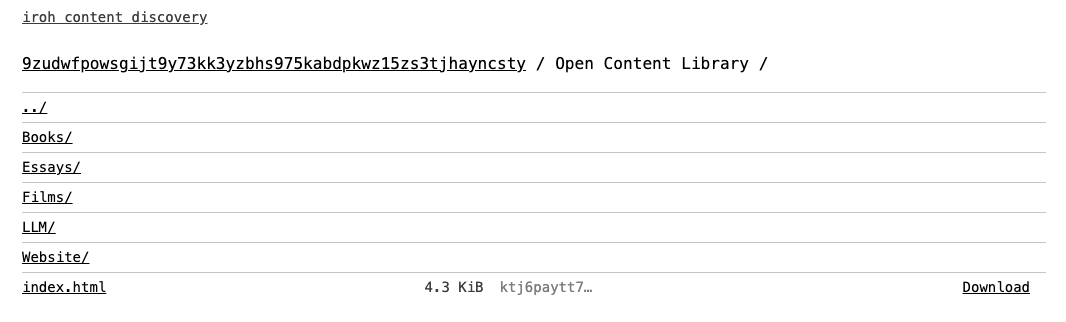
The last component is a local gateway that serves content-addressed data on localhost. It interacts with mainline to find content and orchestrates the actual blobs downloads. It supports iroh-blobs collections and shows a directory index for them. It also does file type detection. It is derived from iroh blobs gateway in iroh-examples.
We could build a service worker to verify the data inside the browser process.
Instead we verify the data inside the gateway.
It is software that you have to trust, whether it lives in the browser process or elsewhere doesn't matter much.
With these two components in place we can browse content-addressed data.
Names
Now we have a mechanism to publish and consume content-addressed data. But we don't have a way to refer to mutable data. You could use blake3.net links from an existing website, but for that you need a registrar and a hoster, so it is not the permissionless publishing we are after.
Fortunately a permissionless DNS system already exists, pkarr. We have been using it for years for endpoint address lookup. So we reserved another domain pkarr.net and added a rewrite rule to the plugin and pkarr support to the gateway.
A pkarr link has the format <name>.pkarr.net, where name is the zbase32 encoding of an Ed25519 public key. The plugin rewrites it to <name>.pkarr.localhost:<port>. The gateway will then resolve the pkarr record and either perform a redirect or directly serve content-addressed data if the pkarr record links to hash.blake3.net.


The pkarr-publish-resolve example in iroh-content-discovery demonstrates the whole workflow: generate a keypair, publish a blob and its name, then resolve the name, discover a provider, and download the verified content from a separate client.
cargo run -p iroh-mainline-endpoint-discovery --example pkarr-publish-resolve -- --once
[1/5] Prepare content and identity
  Generated a keypair. Use --key-file to keep this name.
  Name: https://uinsazmmp47ejo8gs5dbc6rfxya14cgqhxmdqin8ae55w5aqnsio.pkarr.net/
  Blob: https://577jw6j7bjue44tzj8cpucwchh96dnhbhjfkpdd7eymqbaoxf3uo.blake3.net/
  Serving b60a5a944d97eeb82fb1bcbed93ff4bef73cb09ccd348993e04db509f805b74d

[2/5] Publish the endpoint mapping and announce the blob
  Endpoint mapping and provider announcement published.

[3/5] Publish the signed Pkarr name
  Name now points to the blob hash.

[4/5] Resolve the name from an independent DHT client
  Verified signed record. Target:
  577jw6j7bjue44tzj8cpucwchh96dnhbhjfkpdd7eymqbaoxf3uo.blake3.net

[5/5] Discover a provider and download the content
  Mainline infohash: f7d03c142bd009d4dbe98c0de7aed925e22eb9eb
  Provider: 217e9396a7780609a4562e5d022004657d424fb8e605edaad57f5b8bb92be4e3
  Provider: b60a5a944d97eeb82fb1bcbed93ff4bef73cb09ccd348993e04db509f805b74d

Downloaded and BLAKE3-verified 35 bytes in 8.24s.
Content:
  hello from a Pkarr-named iroh blob
Pkarr gives us permissionless names, but not human-readable ones: anyone can generate a keypair and publish under its public key, without asking a naming authority. This is the tradeoff illustrated by Zooko’s triangle: pkarr names are decentralized and cryptographically verifiable, but a 52-character encoded public key is not a memorable name.


You can combine human readable naming systems with pkarr to get a memorable name that you can retarget in a permissionless way. We have some ideas about how to do this, stay tuned.
Trying it out
The first step is to run the local gateway. Most readers of this blog will probably just compile it from source, but there are also installers for windows and MacOS on github.
The next step is to install the browser plugin. We will try to get the plugin into the official stores, but brave allows installing unpacked plugins in developer mode.
Make sure the port configured on the gateway and the browser plugin match. The default is 45475 or B1A3.
And then you are ready to browse the content-addressed web.
Try https://y7rmokt6h5mryuauw83em4u1br6tqrukaw3ngtde7zp8p3bg6hto.blake3.net/ for some static content, or https://5ti57aszf7kaicsncb4wgigkf9bju39kofiz8dthwdujkmz85u8y.pkarr.net/ for a pkarr record currently pointing to the above.
Publishing
Traditional website publishing just means copying your files to a directory on a server. But for content-addressed data and permissionless pkarr DNS records, you are the publisher.
So we wrote a tool iroh-share that simplifies publishing. You can think of it as sendme, but running as a daemon with a separate user interface.
Both content-addressed data and pkarr records need continuous announcements, so you want to run this daemon on a small box in your attic that is on 24/7, or a vm in the cloud.
Recap
We now have a system for global content discovery of BLAKE3 hashed content addressed data. It is far from perfect, but it's a start.
The user interface of sharing content addressed data is extremely simple. You just state what content you want, and the gateway gets it for you.
The system behind it has a lot of room for improvement.
-
Mainline is quite scalable, but it probably won't scale for the vision of making all content on the internet content-addressable.
-
Mainline traffic is also unencrypted and therefore easily blocked by middleboxes.
-
The existing pkarr naming mechanism is using Ed25519 and therefore is not post quantum secure.
-
And perhaps most importantly, mainline does not provide any privacy. If you share content, anybody can look up your ip address.
But we are currently in the food and shelter phase of global content discovery. We will continue to improve the underlying content discovery system, possibly by extending mainline, possibly by writing our own DHT using iroh connections.
But the current system is certainly better than nothing, and we can do all these improvements while keeping the user interface stable.
Footnotes
-
In endgame mode, it may request the same remaining blocks from multiple peers and use whichever responses arrive first. ↩
-
Technically, you can choose the port in an
announce_peerrequest. But that gives you only 16 bits, which is not enough to store, for example, a 32-byte irohEndpointId. ↩ -
This mechanism is similar to the address validation token in QUIC. ↩
To get started, take a look at our docs, dive directly into the code, or chat with us in our discord channel.